Sunday, October 11, 2009

Empower Yourself! - Part XII - And in the end...


Well, we have reached the end of our series on personal finance. I have learned a lot from this experience, and I don’t mean I have learned a lot about finance, I mean that I have learned a lot about people. It is a tad disappointing to me to watch my readership fall as the days go by. On average,  my humble, no name blog gets between 60-130 reads per week, depending on how many entries I do, I have watched that number plummet while I tried to give out important information that might be of some help in today’s trying times. I guess what is truly sad to me is that people are much more entertained by me bitching and complaining than they are by me trying to help out.
                I have come to a realization of late, I have come to realize that there are two types of people in this world, those who complain about things and those who try to fix them. I am tired of being the former, and wish to be the latter. I realize that personal finance isn’t an exciting topic, I know this, but it is important nonetheless. My sincere hope is that people stopped reading because they already know this stuff, if that is the case, bravo! I will be going back to my usual format, but will be making a conscious effort to try and solve problems or recommend better options rather than just lampoon and point out the absurd stupidity of your average American. To those few, very few, who stuck it out until the end, I don’t know who you are but I hope you got something out of this. It took a lot of work on my part and a lot of time, and I enjoyed every second of it, stopping people from ruining their lives is a sort of passion of mine… it’s gotten me in trouble in the past, it may have even cost me a relationship, but I refuse to stay quiet in the face of foolish decisions. Everyone has a right to ruin their lives, but I also have a right to try and stop that! If I didn’t, what good would my complaints be? How could I claim to care about someone or something if I just let it fall to shit? It’s ludicrous (not the rapper).
                At the end of the day, your success or failure at managing your money and preparing for retirement by saving are dependent upon your desire to sacrifice for the greater good. I will say this to those advocates of living life “Day by day”; those who walk life’s path looking straight down at what is right in front of their feet won’t see the Cliffside until they plummet over it. Ponder what I have just said, ponder it well. No one is asking you to plan your life 30 years from now, no one is asking you to fill out a living will at age 29, no one is saying the end is nigh! All I am saying is that it is never too early to prepare yourself.
                Want to get married one day? Want to have kids? Want to visit Egypt before you die? All those dreams take money, and unless you are doing very well and have no debt whatsoever you will probably have to set aside some money. We of the young generation tend to look to our parents for salvation, but we fail to realize that sooner than later, we will probably have to be their salvation… Will you be prepared?
                Our financial crisis is much deeper than a simple economic one… it is a moral cleansing of sorts, the Four Horsemen of Financially Irresponsible Practices I suppose. It may be hard to accept, but we started it, we ignored it, and we have ultimately caused it. Our greed, our desire, our selfishness, has caused the ruination of our once great nation… They have caused America to become little more than a debtor nation that owes more to the rest of the world than it possesses. Our leaders spent irresponsibly and we followed suit, now, we must reap that which we have sown, both personally and as a nation.
                I must tell you, nobody is going to look out for you, nobody. And if you do not empower yourself to make the important decisions prudently you will ultimately be the only one who suffers. That sounds harsh, but truth often is. Lies and pretty songs may be gentle on the ears and the smile, but when the music ends and you are faced with the reality, what do you see?
                I was raised by a single mother, who worked her ass off to support me, and buried herself in debt for a time to provide for me, to make sure I could afford to go to College, to keep me dressed and wearing a pair of shoes without holes in them, even when I was a spoiled asshole of a brat who didn’t appreciate everything she did for me. She did all this, but still saved some money. My mother is the person I love most in this world and she has been my shining example of what is possible in the face of terrible odds and a terrible situation. After I got myself into financial trouble at the ripe old age of 21 and had to rebuild my credit and my reputation number by number, I really began to appreciate what it is she did for me and for herself. Although she never taught me these lessons (maybe part of the reason I messed up so young) she knew them herself. Sometimes parents assume school is teaching their children, often times these important lessons are skipped altogether.
                If we wish to claim that we try to be ‘good people’ we must dutifully try to help others, but before we help others we must first help ourselves.
                I know I said I would put a synopsis here for the lazy… I lied. I just wanted the lazy to read this.

Empower Yourself! - Part XI - The Wild World of Winvestment, pt. 3 (The Dark Side)


Yesterday, we discussed the types of basic transactions and how to read a stock chart. We also discussed the most cost-effective manner of purchasing stocks. Yesterday’s blog was about rational responsibility. Today, we will be taking a walk into the dark side… Today, we will be discussing the riskier forms of investment. It is my hope you will stay away from doing so unless you know what you are doing, but short selling is a reality of the investment game. And as a long-term, stable, calm investor you need to understand shorting, because often times the ones yelling at you to SELL SELL SELL are only doing so to drive the stock down in price because it benefits them.
We quickly discussed short selling in our vocabulary section, but I will go over what ‘shorting’ is one more time. When you invest in a stock directly, you can actually bet on one of two outcomes. Either the stock is going to go up, or the stock is going to go down.  If you think the stock is going to increase in value, you BUY shares and take what is known as a LONG POSITION. If, however, you think the stock is going to tank, you BORROW shares and initiate a SHORT POSITION.
Borrow you say? Yes. You borrow them. You go to your brokerage (online, on the phone, over Dixie cups and string, etc.) and SELL SHORT 100 shares of General Motors at $5.00 a share. The brokerage will lend you the shares to sell to them, and they will deposit the $500.00 from that sale in your brokerage account.
Two very important things have just occurred… First, you have taken a loan of $500.00 on margin at whatever the margin interest rate is. Second, you have entered into an obligation to give 100 shares of General Motors stock back to the brokerage.
What is margin? It is nothing more than a loan against your existing shares of stock. Let’s say your portfolio is worth $10,000 and you apply for margin privileges at your brokerage, they will give you $10,000 (actually less, more on why later) in credit at a variable rate tied to prime in order for you to have a little more to play with. I’m serious. It is a dangerous thing to fiddle with ladies and gentlemen; remember one of our rules from earlier… DON’T PLAY WITH WHAT YOU DON’T HAVE.
Shorting is the one of the few exception to the rule above, and honestly, I don’t recommend short selling to the inexperienced, we will see why in a bit. I have tried to keep a positive tone, in spite of myself, throughout this series! Let’s keep that up and discuss the bright side first.
In our example above, we got the $500.00 in our account and the obligation to pay back 100 shares of GM. Let’s just say… oh I don’t know… that GM went bankrupt. We could then walk up (in the virtual world) to our brokerage and hand them 100 shares of $0.10 a share GM stock and the obligation would be met leaving us with the $490 as profit. Actually, it would be a little less to a lot less depending on brokerage fees and how long we had to wait for that to occur, remember, we are paying interest on that $500.00 margin loan! (The good news is that the interest is tax deductable!) I hope this gives you a small idea of why shorting might be a bit on the risky side… If it didn’t, let’s take a look at the “2012 Mayan Prophecy Apocalypse Scenario”.


We are sitting pretty with our $500.00 cash money. We have converted it into one dollar bills so that we can go to the strip club and “Make it Rain” like Pac Man Jones. We go out, party, drink, live it up and tell all of our friends and family how we’re going to ‘make a killing on this GM thing.’ The stock does begin to fall a little, but one day, Saudi Prince Bandar, touched by youthful memories of dessert quickies in his Corvette, decides that GM is too important to die (especially given some of their EPA ratings). He gives, free of charge, enough money to free General Motors from all of its debt! The stock market goes apeshit with this news! All of a sudden, GM stock rises like the great Peter North himself and ends the day at $25.00 a share. Guess what mon ami… You still owe the brokerage 100 shares of GM stock, which is now valued at $2,500.00.
Miamians… Americans, of both the Northern and Southern Hemisphere, I know exactly what you are thinking. “So what! I’ll just leave it there… you never said I had to pay them back in any given amount of time, besides, 6% interest isn’t that bad, my credit cards are easily double that!” Au contraire mon frère!
You see, using Margin is a dangerous thing for several reasons… There are two words that every fund manager, investor, or trader never wants to hear. MARGIN CAAAALL! A Margin Call occurs when the percentage owed falls out of whack with your actual equity. As we know from earlier, Margin is borrowing against the value of your investment portfolio… If your stocks go DOWN in value, or a short position goes out of control, your ‘collateral’ will all of a sudden no longer be sufficient. A Margin Call, is a loan shark coming to collect what he is owed. Look at it that way, because that is what it is… except that instead of breaking your legs, they can go in and SELL all of your stocks to cover what you owe them… And if you’re in a down market, when many of those stocks are at historic lows (like last year) you can turn what seemed to be a silly $500.00 bet on GM into a several thousand dollar debt spiral ordeal. It happens all the time believe it or not.
Shorting does have its legitimate uses in the world of investment; sometimes shorting can be used to hedge (offset) a long investment. This is part of the concept behind options and futures trading, which we will not discuss in this series, as it has no part in the life of your average American (Unless you are a farmer or are in a commodity based industry). But the truth is that you should not try to short stocks haphazardly, because you have more than everything to lose. With a stock, even if the company goes bankrupt, the most you lose is your initial investment. With a short position, as in our example above, you could end up losing more than your initial investment.
So why am I try to scare you with the scenario above? Because I don’t want you to think you are Gordon Gecko or “a hot-shot home-game wall street-wannabe-asshole”. I want you to do what our grandparents did. I want you to believe. I want you to buy smart, and I want you to buy loyally. What do I mean by that? If you want to invest, if you choose to put your backing behind a company don’t just buy a couple of shares, then go buy another company next month, and so on and so forth. You must increase your position, reinvest your dividends and keep acquiring more shares. Have the discipline to add a little to the pile, even if it’s a share at a time. Sometimes, you will come out ahead (when the market is down) other times you will pay more (when the market is up). Over time, you will learn to love those down days, because of how much more you are getting for your dollar. This is counterintuitive, but true. Don’t give up, don’t give in, keep at it. Be a diligent investor. Trading and investing, are two completely different things which people often confuse. An investor does not constantly buy and sell, a trader does, there is a fundamental difference. That being said… sometimes, it makes sense to sell! But there is one more thing you must do, that is done by both traders and investors (at least the smart ones)
You must do your research and attend the company conference calls (or the replays). You must read the annual report,  and you must do so much more. To a point, to be good at picking winning companies you must look at the world around you! Are there any socio-political, economic, legal, or environmental factors that may affect this company? How does a drought in a place where they grow a lot of wheat affect Pillsbury? If you hadn’t guessed, increased flour prices due to lower availability of wheat, perhaps the increased gas costs last year caused profits to drop. Each and every company out there is affected by a number of factors, from within, from its industry, from its state, from its country, from the world! You must know your company and know it well, and yes, I mean YOUR company, because by owning shares you own a piece of it.
I know I sound like a broken record. I do so, because this is important stuff. Many a person has lost their ass or worse, the ass of others in the investment game. The only way to truly win at it, is to be patient, be persistent, be unafraid! Because the truth is, you haven’t lost a penny, until you sell the stock! That’s the big secret. If you learn anything from this series, let it be that you should not be afraid of something as silly as money.
Tomorrow, we summarize (for you lazy sons of bitches) and wrap it up.

Empower Yourself! - Part X - Wild World of Winvestment! pt. 2


The first step in understanding the market is to understand a typical stock quote. People, LOVE stock quotes… even if they don’t understand what half of the values are, why they matter, or what the shorthand even stands for! They love them, because there are lots of little numbers and percentages and ratios, and nothing makes you look smarter on the bus than reading the final pages of the business section where all the numbers are. Well, perhaps that is an antiquated notion… Nowadays, it would be looking up real time quotes on your ‘IPhone 3GS.’
Now, Let us pray… And now, let us look at a typical stock quote!


          As you can see, there is a veritable assload of information in this little box. Let’s take it from the top! The top line shows the price, below it you can see the time (as of 4:05pm EST) The little red arrow and the -0.06 means the stock has lost .06 points, during the day this number goes up and down, but the market closes at 4:00pm, so that’s the end of market price (We will not be discussing after-hours trading in this blog because I do not agree with it.)

Below it, you see the day’s low and high. I think these are self-explanatory… The VOLUME is the number of shares that traded that day, this particular stock traded 23.14 million shares that day. Below it, is the 30-day average volume, also self explanatory.
Market Cap. Is short for Market Capitalization, and is the total worth of all the outstanding shares. In this company’s case it is 61.48 billion dollars. To reach this number, you multiply the number of outstanding shares by the individual share price and BAM, Market Cap. This figure is typically used to categorize companies by size, and is not a measure of how good/bad they are doing.
The Shares Out is the number of shares outstanding, in this case there are 3.61 billion shares out on the market.
Revenue is also pretty self explanatory, it is the amount of money brought in by the company. Again, this should NOT be used to judge the company for one very important reason… This just tells us how much came in, not how much went out, or more importantly HOW it went out.
Earnings refers to the amount of profit (or lack thereof) of a company during a period, either quarterly or yearly. Earnings are very important, but are not the only thing that must be considered… From the earnings number we can see how profitable a firm is. But there is a caveat, numbers can be played with and sometimes spectacular earnings can be produced by a one-time event like a sale of some property or a business unit. One must see beyond earnings to understand if they are going to continue in the long term or not. Companies also issue something called “Guidance” which is what their projected expectations for the year are… Often times you will hear people say “So and So lowered their guidance due to the availability of more absorbent maxi pads…” This is Jargon for “Things are gonna get worse.”
EPS is short for Earnings Per Share. This one is also self explanatory, but bears discussion. The “Earnings Per Share” are what each individual share earned in profit in that specific period. In this case, Each share was worth $1.23 in profit for that period. I know, I know… Why does it cost $17.01 when it’s only earning me $1.23… Actually, unless they declare a $1.23 dividend (which wouldn’t happen) it wouldn’t earn you a goddamned dime.
The 52-Wk Low and High are the Lowest and Highest prices this stock has reached in the last 52-weeks (a year). From this we can get an idea of how the stock has performed, and if we see something like a Low of $0.79 and a High of $100.00, we might just want to go see WHAT happened before we take that plunge. This is a useful number for wrapping your mind around the semi-long term performance of a stock… Most online stock quotes nowadays have adjustable 3mnth, 6mnth, 1yr, 5yr, 10yr charts at the click of a button, very nice, but you will still also see the figures above displayed on the table! Tradition!
Prev. Close and Today’s Open speak for themselves…
Dividend and Dividend Yield give you the amount (if any) of dividend paid, and how it stacks up against the share price… The higher the dividend yield (typically) the higher the dividend. In our example above, this company pays a $0.25 dividend per share (probably each quarter [only if they declare one]) which amounts to 1.45% of the cost of a share. I warn you, do not think that a stock with a 10000% dividend yield is the one to buy… Dividends are fickle, and are not reason alone to invest in a company. In our grandparent’s day, it was a reason, a company like Parker Hannifin has  paid a dividend for FIFTY-ONE YEARS STRAIGHT. But nowadays, many companies do not pay them at all.
The Beta is a measure of Volatility. A beta of “1” tells you that the company is moving in line with the general market, below “1” means it will be less volatile than the market, and above “1” means it will be MORE volatile than the market. As you can imagine, much like gambling, investing yields higher returns to those who engage in higher risk. It also destroys people in the same way as gambling, so beware.
Finally we get to the P/E Ratio! P/E stands for Price/Earnings and it is just that… the ratio of the share price to the earnings. You will notice there are 2 P/E ratios, the first one, labeled (TTM) stands for “Trailing-Twelve Month” and gives you an idea of what a 12-month time frame looks like, today it would be Aug09-Aug08, etc. The one labeled (Fwd.) is the FORWARD price/earnings ratio. This figure is a projection using expected earnings rather than past or current data. Not at all as reliable.
So… Where do we go from here? As I said, I am not going to give you stock tips, so we are going to skip the choosing of your particular stocks. I don’t want to know what formula you used, I don’t want to know what your cousin Bernice told you to invest in, or what San Lazaro told you to invest in during a dream, I don’t care, I don’t want to know. Let’s just say for argument’s sake that you are going to buy 5 companies, $1000.00 each, as we discussed yesterday.
Are we going to buy them all at once? NO!
Are we going to buy them using ‘Market Orders’ FUCK NO!
Let’s proceed by stepping back… There is a multitude of ways to buy and sell a stock. You can place a market order, a g-t-c limit order, a day order, a fill-or-kill order, a sell-stop order, a buy-stop order, a trailing stop order, a stop-limit order tick sensitivem-i-tOCODiscretionary… *faint*

Oh come now, don’t be a little punk ass bitch, it’s not that bad… Really, they break down into a few simple categories and do a few simple things which once thought about, make sense just from the name. Let’s talk about the basics first.
Market Order – Means BUY RIGHT NOW at whatever price. I don’t like market orders, they are an excuse for you to get screwed over a few extra pennies. I never, ever, use market orders. I don’t recommend you use them either.
Limit Order – A limit order means that you place a price limit on how much you are willing to pay per share. Limit orders come in several flavors:
·         G-T-C – Good-Till-Cancelled limit orders are just that, good until you cancel them or they are fulfilled. For example, if you wanted to buy 10 shares of GE at $10.00 limit, good-till-cancelled, your order would remain open until the stock reached 10.00, at which point the brokerage buys 10 shares or until you cancel it.
·         day order expires at the end of the trading day. In other words, if I setup a $10.00 limit on ten shares of GE this morning, the order will automatically expires when the market closes that day.
·         Fill-or-Kill limit order either results in a sale or a cancelled order.
·         An OCO or (One-Cancels-Other) order is one where you wish to place two different orders, only one of which will be fulfilled… In other words, you place one limit order for 10 shares of Microsoft at $20.00 and one limit order of 10 shares of Cisco at $20.00, whichever hits that limit amount first will be purchased and the other order will be cancelled.


Stop Order – A stop order tells the brokerage to buy or sell above or below a certain point.  And like limit orders, they come in 31 flavors:
·         Buy Stop Order – A Buy Stop Order is usually used by short sellers, though it can also have uses for those who invest long… A Buy Stop instructs the brokerage to BUY shares once the price goes above a certain point. The reason why short sellers tend to use this more than anyone else is due to the fact that shorts need to ‘cover’ (more on this next section) in order actually make any money.
·         Sell Stop Order – A Sell Stop Order tells the brokerage to sell if the stock falls below a certain point. Let’s say for example you set a Sell Stop at $10.00, if the stock falls to ten dollars, the brokerage will immediately try to sell the stock at the best available market price.
·         Trailing Stop Order – A Trailing Stop Order sets a parameter which tells the brokerage to sell when a certain number is reached. A simple example… I place a trailing-stop order to sell 100 shares of Microsoft if the price falls $2.00 below market price. If it falls a dollar, nothing happens, if it falls a $1.99 nothing happens, but once it hits $2.00 the brokerage will sell at best market price. The nice thing about trailing stops is that they adjust with the stock price, in other words, if Microsoft goes up to $30.00 a share, my trailing stop will be $28.00. These also come in ‘limit order’ flavor (My preference)… this type of order isn’t used enough in my opinion. It is quite a useful little tool.
·         Stop Limit Order – A stop limit order is just like a stop order except it has a price sell limit instead of market sell limit.


As you can see, there are many different ways to buy and sell a stock… most brokerages charge extra for fancy orders like Trailing Stops, but for those disciplined enough to use and keep up with them they can be a blessing. Think about it, in a way some of these order types keep a constant, second to second watch on the market for you… there is no way in hell you could be as precise as a Trailing Stop, so why not use them?
Well… Sometimes you can’t. For those of us in the commercial banking industry and other sensitive industries there exist workplace investment policies… I won’t go into the specifics of mine, but I will tell you that it is draconian enough where the only type of orders that make any sense for me are day limit orders. If you are under the auspices of such an organization, they will likely be your best bet as well. Otherwise, please look into some of the funkier flavors listed above, they might just mean less work and more profit.
So, we are *finally* ready to purchase our stocks… as I said before, it would be foolish to purchase all the shares at once. Why? Because the market fluctuates… If you spread your lots out you have a better chance of getting the best price possible. Now, there is a warning here… this is STUPID to do if you are buying 5-10 shares… keep in mind your brokerage is going to charge you PER transaction, so each lot will cost you whatever the commission is. You will absolutely blow any possible savings out of the water if you buy 10 lots of 10 shares. This strategy should only be used for large lots where a dollar difference could mean a hundred dollars savings.
For simplicity’s sake, let’s say we now own 100 shares each of 5 stocks, totaling a $5,000.00 investment. Congratulations… you are now a self-directed investor…. Now what?
Tune in tomorrow for the thrilling conclusion of… How to keep calm and not lose your ass!

Empower Yourself! - Part IX - The Wild World of Winvestment, pt. 1


I must, by law, begin this section by telling you that I am not a licensed financial advisor. I do not hold any licenses or certifications. I do not work for a brokerage, I will not be giving you *any* stock tips or individual stocks to invest in. Any companies I use as examples will be just that, examples, and used anecdotally unless otherwise indicated. I also do not wear Pinstripe suits, do cocaine, or take clients out golfing.
With my disclaimer out of the way, we can begin our discussion about investments. I am going to defer to the Wikipedia definition of ‘Investment’ because I think it is perfectly ambiguous, which, with investments we kind of need to be, as it is a rather broad category.
“Investing is the active redirection of resources: from being consumed today, to creating benefits in the future; the use of assets to earn income or profit.”

We can invest in a great many things… years ago, a family member invested $1,000 in Fred De Luca’s ideas to sell sandwiches to pay for College. Today, that company is known as “Subway”. Likewise we could have bought thousands of shares of fledgling Microsoft or McDonalds and been retired today. If we were afraid the end of the world was nigh, we could take out our life savings and buy gold bullion coins or bars, or invest in a foreign currency. If we believed California was going to rebound, we could invest money in those junk bonds the state issues, and if we were right, we might just make out like bandits. In other words, investing is putting your money into something you believe will make a profit in order to earn more than what you initially put in. Simple, yet so complex.
The first, immediate, number one, numbero uno, ichiban, form of investment you should take part in is your company 401k! We briefly covered this in a previous chapter, but it bears repeating, your 401k money comes out of your check before taxes. What does that mean? It means that since I contribute 15% of each paycheck to my plan, I only pay 85% of my wages in tax at the end of the year… that’s a big bump in many cases, sometimes enough to change your entire tax outlook from depressing to delightful. Also, most companies offer some sort of match… If your company matches you 100% up to 5%, that’s a 5% RAISE for you right off the bat without even asking for it, most companies give 2% or 3%! There is no better way to form savings discipline than by doing this.
The downside, is that most 401k plans are invested in mutual funds. Downside, or upside depending on how you choose to view things. Last year I watched my money evaporate, seriously, it literally evaporated into thin air. But not REALLY, you see, I didn’t cash it out, I didn’t sell it, in fact, I pumped MORE money into the most troubled sector funds. Why? Am I suicidal? No, I am young. I have a high risk tolerance, and maybe I am stupid. Actually no, the reason why is because by the very virtue of my stocks losing value, buying them became cheaper.
A quick example… Mutual Fund A sells shares for 10.00. Each week, my paycheck puts $300 toward Mutual Fund A, that means I buy 30 shares per week. A few months down the line, times are good, and my 401k balance looks good, Mutual Fund A sells at $60.00 a share! While that means that the 30 I bought at 10 dollars are now worth $1800.00, it also means that next week, when my $300.00 are applied to buy Mutual Fund A, I will only be able to buy 5 shares instead of my usual 30!
Conversely, when the market is down, and Mutual Fund A is at $1.00 per share, and I am looking at my shrinking balance with a bottle of whisky and a bottle of Percocet in my hand, ready to sleep the long sleep like Marilyn Monroe, my $300 buys me 300 shares! See? There is always a bright side. I can attest to this, because during the recent ‘troubles’ in late 08 – early 09, I shifted ALL of my 401k future allotments into the banking sector and made out like a fucking bandit. Stock fund shares for the banking sector (not naming names on purpose) were at costs of a dollar and change, when the year before they had been at $19.00! Today they sit at around $6.00. But for a few months, I was buying shares at a frenzied pace because they were dirt cheap. I only knew this because I know how to read a few simple things on my statement. With that, let’s talk specifics!
Let’s get ourselves acquainted with mutual funds so that we may better understand! A Mutual Fund is a managed fund that pools investments into neat little packages. They are typically industry based or sector based, although there are trends now toward ‘target funds’ where you choose your retirement date, let’s say 2030, and the fund will (in theory) adjust over time to become more and more conservative the closer you get to retirement date. Funds are also categorized by their risk tolerance or market capitalization (micro cap, small cap, midcap, large cap). The market capitalization is nothing more than the value of their total shares (to grossly oversimplify) and adjusts as a stock moves up or down. Most 401k plans will also offer several bond or money market funds with very low yields for those with a low tolerance for risk. Often these funds will yield less than the rate of inflation so there is a downside.
“Shares” of a mutual fund are valued and expressed in a term known as NAV (Net Asset Value) which is basically the book value (asset-liability) of the pool of investments. When you see your statement, the NAV is what your shares are worth. And if it were as simple as just watching the NAV go up and down and buying and selling as it does, we’d all be rich and these Wall Street douche bags would be homeless and living under the Rickenbacker causeway with the pedophiles.  Again, this is a game of chance and a confusing one at that… We have to look at the COSTS of buying and selling these shares to know just how much this ‘investment’ is costing us… What? You thought they were offering you these funds out of the kindness of their heart?
Fees on a mutual fund are known as “Loads” which is a GREAT term for them, because they most often are a load of shit. There are two types of loads, front loads and back loads. A front load means they are charging you the cost up front, when you buy the shares. A back load, as you might already have deduced, is charged when you exit the fund or sell shares. There is also a third category, the constant-load, where they just fuck you all the time. And then, there is the NO-LOAD fund! You typically won’t find these in your 401k options, but if you personally wish to invest in a fund, you’ll certainly want to look into them.
These loads are very important, because they can really add up. In fact, they average around 5%, and if you aren’t careful you could be losing your entire match or even some of your own investment! Always, always, do your research! I will say this over and over again during this chapter because with investment it is essential. Most workplaces with options have some sort of online system for you to log in and do your benefit elections. In the 401k section you will typically find the prospectus or costs associated with each fund, look very carefully at this… How has the fund been doing? Where is it spending its profits? Is the fund manager earning $100,000,000 a year? Is their 12b-1 expenditure (cost of marketing to potential investors) ridiculous because they want to buy 20 minutes during next year’s super bowl? Remember, all of these costs get passed on to you in one way or another, so beware! It is known as the fund’s “Expense Ratio”.
The last thing I will say about your 401k is this… DON’T TOUCH IT. Do not, under any circumstances, withdraw money or take a loan against your 401k. There are very strict tax codes which govern these plans and early withdraw usually means getting screwed with tax penalties. Is a vacation or a new set of rims worth it? No. Be disciplined.
This leads me to the wild world of self-directed investing. But first, another disclaimer…
DO NOT OPEN AN INVESTMENT ACCOUNT AND PLAY WITH MONEY YOU DON’T HAVE IN HOPES OF MAKING MONEY YOU WON’T MAKE. DO NOT SKIP YOUR 401K OR SAVINGS ACCOUNT DEPOSITS BECAUSE YOU BELIEVE YOUR UNCLE JOE’S STOCK TIP IS GOING TO RETURN YOU 1000% IN A MONTH. DO NOT PLAY WITH THE RENT MONEY, ALLOWANCE MONEY, WEDDING SAVINGS, BAR MITZVAH FUND, CHRISTMAS CLUB, OR ANY OTHER MONEY WHICH YOU DO NOT CONSIDER TO BE ABSOLUTELY EXPENDABLE!             *whew*
With that out of the way, let’s talk stocks! The world of stock trading may seem exciting, it may seem like the glitz and glamour of Wall Street calls to you, the fast paced action of the pits, BUY BUY BUY! SELL SELL SELL! The truth of the matter is that most of us are destined to lose in the stock game because they are a bunch of backstabbing cheaters who manipulate stocks and the news to try and get a reaction out of people. They don’t respect us as self-directed investors, they think we are dumb and uneducated and weak, and often times they are right. Many a fool (including this one) has bought into many a bubble over the years, and as you can imagine, though the institutions also took some nasty hits, they fared well better than any of us did.
There are many brokers out there for those wishing to open an account. Nowadays it’s much easier than times past. You can use the internet to place orders, or manage your portfolio in real time. And the fees fluctuate wildly. From your ZECCO TRADING which gives you 10 FREE trades a month (protip: most people won’t make more than 10 trades a month), to E*Trade, which will give you an iphone app to buy/sell stocks but also charge you $12.95 per order (buy OR sell). Go with whichever one you want, odds are if you need to read this posting to understand stock trading you won’t need powerful tools and level II quotes. But again, DO YOUR RESEARCH.
We’ve got our trading account established and have it funded with an initial deposit of $5000.00. Now, we have to buy some stocks! The first thing we will want to do is turn on CNBC and watch the shows on there for a few days… JUST KIDDING. The first thing we want to do is establish our objectives. Are you looking for some quick cash? Are you looking to start a small account and grow it over time? If you chose the first, get the fuck out of here and read the first post in this series again… If you chose the second, congratulations, let’s get to work.
Diversification is a wise strategy for investment. To simplify it and get away from the jargon, ‘Don’t put all of your eggs into one basket.’ Let’s, for simplicity’s sake, say you wanted to invest in 5 stocks, $1000.00 each.  Should you choose Cisco, Microsoft, Redhat, Oracle, and NVIDIA? No, no you should not. Because all five of them are in the tech sector, and if tech experiences a catastrophe you will, likewise, experience it. That is why diversification pays dividends! Typically when something is up, another thing is down, again a gross oversimplification, but true most of the time.  On the other hand, if you bought a tech company, an agriculture firm, a telecommunications firm, a retail store, and a food company you would have effectively spread your money out and into a variety of places. Most of which won’t overlap. I highly recommend it. I once, out of greed, did not heed the warnings of diversification and ended up taking a hit because of it, because when one sector dropped, I lost on 2 individual companies.
How you choose these companies is up to you… Personally, I recommend doing some industry research. Any publicly traded company, by virtue of being so, will have an ‘investor relations’ tab on their website, in it you will find all pertinent documents such as the annual report, insider buying/selling, etc. By seeing the numbers, reading the story, and making an informed decision you will greatly mitigate your risk. DO NOT LISTEN TO TIPS! From anybody, I don’t care if they WORK on Wall Street, always verify any claims made by anyone, do not trust their business acumen. Do not trust their claims, because even if they aren’t trying to mislead you, someone may have misled them! There is no substitute for due diligence here ladies and gents… If you DON’T want to do it, DON’T become a self-directed investor, just give your money over to some scumbag at a firm to manage for you, or better yet, increase that 401k contribution or savings account!
People who work on Wall Street, with few exceptions, are backstabbing opportunistic fucks. The predominant ethos on “The Street” is “Eat what you Kill”. In other words, one should reap the rewards of that which they have accomplished. This, is a dangerous way to think, because clients should not be viewed as prey. Unfortunately that sort of mentality leads to the breaking of many promises and deep delving into the murky, gray, area of securities law.
I am just trying to give you an idea of what you are up against as a self-directed investor in a sea of sharks. Don’t trust message boards, don’t trust individuals, and don’t trust investment newsletters or analysts. Trust the numbers and trust in your ability to sniff out bullshit. Listen to the quarterly conference calls and the annual meeting, because you may be able to tell by the way the CEO is speaking or the tone of his voice just how you ought to feel about the future. The best way to win at the trading game, if it’s even possible, is by being diligent and being informed. There is NO SUBSTITUTE FOR HARD WORK.
Now that we have discussed the theory of investing, we will shift to the practical side of investing, and how to get the most out of our investment experience. That will have to wait until tomorrow though.

Empower Yourself! - Part VIII - Mr. Mortgage, Mr. Mortgage with your pokey little flat.


Did you notice that I mislabeled my last blog? Did you, even in roman numerals, realize the discrepancy? Did you quiver with fear when I said my blog would be delivered “tomorrow” and here we are a week later with no new post? If you’ve answered ‘yes’ to any of these questions then you should seriously consider a job in “Loss Prevention” or “Risk Management” or, god-forbid, “underwriting”…  If you answered no, then I have just explained away my laziness, the fact I was on vacation, and a simple typo with enough logic to convince you it was planned. It wasn’t.
Underwriters (the people who approve or deny your loan request) view these things and more… I give you the perspective of someone on the sales side of the banking equation, credit people on the other hand, especially nowadays, are looking for any and every reason not to give you a loan or a mortgage. My humble reader, do not take it personally, it is simply a matter of fact… Right now, lenders want to lend to only the most lendable, and there are sometimes incentives to *not* loan! Couple that with the fact that ‘credit people’ have the sourest and most apocalyptic views on most anything and anybody. Their numbers speak for them, and if you aren’t ready, you aren’t getting a loan. And if by chance they are willing to consider it, you will almost wish they hadn’t.
That’s why your best rates can usually be found, no surprise, at your friendly neighborhood credit union. However, as with all things, it is best to thoroughly investigate all options before jumping into a 30-year relationship, with the mortgage consider nothing but the total cost! Because there are ways they can screw you while giving you a nice low rate, whether bank, credit union, or mortgage broker.
Now I am not a mortgage broker or a realtor, and I am not going to sit here for one moment and pretend that I am, as that would be a great disservice to you, my readers. Instead, I am going to wholeheartedly recommend that you find yourself a staff of professionals to help you through something as complicated as buying a house. Think of them as your ‘Queer Eye for the Straight Guy’ for the real estate world. Your Faaaabulous house buying crew! Let’s meet them! *start house music*
First of all, your Realtor! *comes out prancing and twirling* it is their job to make sure you aren’t getting screwed! Your realtor is your personal line of defense, your praetorian guard. It always helps to get someone you trust, because someone in such an important role is also best equipped to screw you. Many an unscrupulous Realtor during the mortgage crisis formed up with others in complementary fields (appraisal, mortgage) to maximize their own profits while seriously screwing their clients. You probably don’t want to pick your Realtor out of a phone book or off Craigslist; the best way is to have someone you know personally, or to get a referral from someone who had a good experience. A good one is worth their weight in gold, even if those are their demands.
Second, it’s that bad boy you hate to love and love to hate, your Mortgage Broker! *walks out and ‘pops his collar’* A mortgage broker works as a freelance headhunter, pairing people who need mortgages with those willing to give them. Unlike a Loan Officer (who makes loans directly for a bank), a mortgage broker typically offers products from several lenders and is typically paid more per loan. This incentivized a lot of brokers to commit horribly criminal acts that were completely legal during the housing boom which has since gone bust. However, the added competition and the fact that they have to disclose more detailed information to the borrower than banks do, is a good reason to consider going with one! Like I said before, do your research! Which is a segue into our last and most oft overlooked party in a real estate transaction… the man with ‘the man’s’ plan in his haaand! Your friend and no one else’s, at least while under retainer, your… Real… Estate… Attorneeeeeyyyyy! *Power walks to the end of the catwalk*
Our government in the US is composed of three branches, the Legislative, the Executive, and the Judiciary. While the first two fuck around with and tinker and try to make things work to their interest, or what they perceive our interests to be, the Judiciary is there to put a stop to any bullshit they may try to pass off as fact or law. This is a perfect analogy for the place of the real estate attorney in your trio of advisors. It is sad, but a real estate attorney is not a mandatory part of the home buying process, because they really should be. Loans are pretty damned complicated. If you read the covenants and the “if, and, but” you may end up not knowing which way is north and which way is south. Most people, and this is no insult on anyone’s intelligence, cannot understand legal documents. That’s the whole reason lawyers get to charge what they do, because they can understand them. The problem is compounded when you live in an area with large populations that either don’t speak English or speak it as a second language, more often than not people in this demographic get targeted due to their weakness in the language and limited understanding of the legal system. It is a deplorable practice, but in 2004, people weren’t asking questions and were handing out loans without income verification.
A wise person, a truly wise person, knows their faults and readily admits them. But furthermore, they know that when treading into unknown waters, it is wisest to hire a guide. Far too many people are far too cocky when it comes to admitting they need someone’s help, it’s like refusing to ask for directions, except that it could end up costing you tens of thousands of dollars more. A real estate attorney will do more than just read contracts for you, they will look into local community laws, association laws, miscellaneous ordinances, that may change your mind about buying that house. Remember, your typical association has a whole set of rules as well, which are written in the spooky and mystical language of law and legislation. You may find your association has a clause where members have to pay for a broken elevator in case of an emergency, and that in such a case the cost is equally split among the units, and your proportional share could be $10,000. A rudimentary example, not at all written in legalese, but if it were you probably wouldn’t have understood it.
Now that we have our fabulous crew in place, or even BEFORE we get our fabulous crew in place, we must take a moment to do something very important. Look in the mirror, look deep in the mirror and KNOW THYSELF. No, seriously, know thyself! Because you are about to enter into a very, very long commitment and you do not want to enter into it foolishly. How much can you realistically afford to spend on a house? And by realistically, I mean will there be money after each pay check to put away for savings, or 401k, or for your kids’ college plan, or Christmas presents or illness or whatever might arise? If the answer is no, think about a smaller house or think about renting. Owning a home is not an investment, as people love to say. Owning a home is just that, a roof over your head, a place that belongs to you. Do not confuse the two and rationalize a lack of saving money because you are ‘investing’ in a house. This is the biggest mistake people of this generation make, our grandparents and parents did not view their homes as investments.
There is a lot more that goes into buying a home than just the mortgage. Consider taxes, insurance (which in Florida is essential and expensive), money for repairs, utilities, association fees (if applicable) and any added costs that buying a home would incur. Can you really afford this place? In other words, if you lost your job for any reason would you be able to pay that monkey on your back until you found a new job? These are tough questions, and we often prefer to ignore the tough questions, but we do so at our own peril. So how do we avoid these mistakes? We use the interwebs! There are a plethora of sites out there that offer mortgage calculators and personal finance calculators that will help you understand what you are truly getting into, use them, even if you don’t like the results. As the old saying goes, Caveat Emptor Let the buyer beware!
That being said, if you pass the gauntlet, this is a fan-fucking-tabulous time to buy a property in south Florida. The prices are very nice and there are government deals and tax credits galore for those who qualify (Check out the FHA website for some of these programs). But remember, once you do decide to buy, be a good emperor and gather your loyal advisors.
I want to end on a very serious note here. Buying a house is one of the biggest decisions you will make in your life. There has been, in recent years past, a certain casino aspect to owning a home, with middle class dimwits walking around talking about ‘flipping properties’.  When it came down to it most of them were ‘flipped’ on their back and forcefed foreclosures. I have tried to stress throughout this series an emphasis on personal responsibility… This is especially important when you buy a house, as it is no laughing matter. This decision must be viewed with the gravity of marriage or entering into the catholic priesthood. A diamond is forever, but sometimes, so is a mortgage. In the end, if you bite off more than you can chew, even if you walk out of it with your wallet intact and a ten year stain on your record, what should really be upsetting is all the money you poured into something which you have now lost. That is the saddest part of playing the real estate game. In short, it isn’t a game, don’t act like it is, because in most games of chance, the house has the advantage. This would be no different.
Tomorrow we reach the final leg of our financial quest! The Wild and Wonderful World of Winvestment! …Sorry, had to get that last ‘W’ in there, and now that I look at it, I like it!

Empower Yourself! - Part VIII - Idle Hands are the Devil's Plaything!


There is something you should know. Credit, is Satan’s favorite tool. And many of the things credit card issuers do, in my opinion, are immoral and should be illegal. Giving an 18 year old with a 12 hour a week job and no credit a credit card is irresponsible. Giving them 2 is crazy. The fact that the more debt they accumulate the more credit is given to them is even crazier than that! The fact that they want to get us hooked on a cycle of payment and repayment for life is just sad. Sad but true. A few statistics…


·         
The average outstanding credit card debt for households that have a credit card was $10,679 at the end of 2008.. (Source: Nilson Report, April 2009)


·         
Young Americans now have the second highest rate of bankruptcy, just after those aged 35 to 44. The rate among 25- to 34-year-olds increased between 1991 and 2001, indicating that this generation is more likely to file bankruptcy as young adults than were young boomers at the same age. (Source: "Generation Broke: Growth of Debt Among Young Americans")


·         
One in six families with credit cards pays only the minimum due every month. (Source: Experian national score index study, February 2007)


I have some bad news for you sunshine… If you pay the minimum every month, you will die in debt. There is no way to win by paying the minimums. Many people live in a sad, sad cycle of paying endless interest, looking at a principal amount that goes down pennies, if even. In some sad cases, you may just be mounting more and more debt on there.


Let’s take a look at a scenario. Mike Jones is a college student who is studying physics but has a love for massive wheels. He decides he wants to put 26 inch rims on his late model Geo Metro but does not have the money for it. Mike, however, has a nice new credit card issued to him by the bank with a $5,000 limit on it. Mike knows deep inside that this is wrong, but he never learned the simple lessons of finance and fell into the great American trap, Mike’s minimum payment was Interest owed +1% of his balance, that’s NOTHING he says! Of course Mike, being a student, doesn’t get the best rates out there. This one card though, gives him 15% APR, which wouldn’t be bad for a student with no credit history Mike’s new wheels are going to run him $4500 mounted and balanced, he goes home and like Gollum from the Lord of the Rings, creeps into his drawer and pulls out his preciousssss. The dark eye of Sauron awakens and mike goes and gets himself some new rims. Mike’s minimum payment is 100 a month, like the idiot that he is, he figured interest won’t be a big deal and according to his calculations… ($4500 x 15% = $675, plus the original $4500 gives us… $5175, divide that by 100 dollars and we get 51.75!) Mike thinks it’s going to take him 52 months to get out of the hole. Mike, is fucked.


Here is the reality. By paying the minimum amount, Mike’s rims are going to end up costing him nearly $1000 more than the rims themselves! He will have paid, by the time he is done, $5,164.89 in interest. His rims, will have cost him $9664. Want to know how long it’s going to take Mike to pay those rims off? TWENTY ONE AND A HALF YEARS. The worst thing is that my calculation is the best case scenario, Mike buys the rims and never uses the card again, if he kept revolving things on it the cycle would never end. I’ve seen people make mistakes like these for years, made a few myself… But my time in banking has shown me that your average person is incredibly irresponsible with their personal credit.


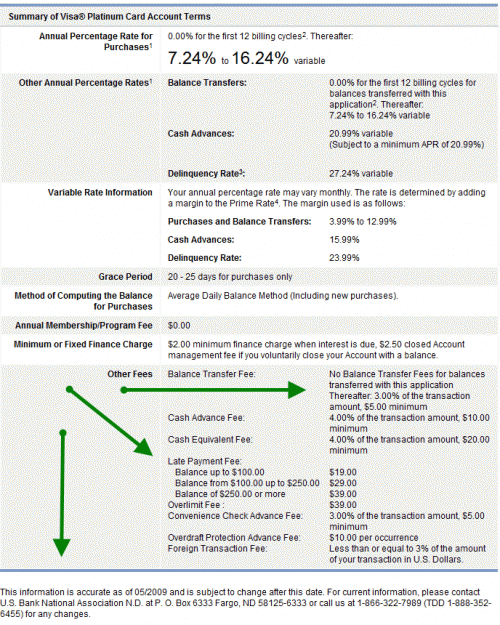
THIS is a sample of a Credit Card Disclosure/Terms and Conditions. The first thing that should stick out at you are the myriad fees these cocksuckers want to charge you, but for most people the first thing that sticks out is that 0% at the top. All credit card rates are variable, and are usually tied to the prime rate, so right off the bat you can see that we’ve got some room for trouble, because the difference between 7.24% and 16.24% is rather large. But that’s not the worst part. See that 27.24% delinquency rate? That isn’t the percentage of people you know who are delinquents, it means that if you are late, even one day, with a payment and sometimes not even that, they can set your rate to 27.24% If we thought Mike had it tough paying 15% for 21 years, imagine what will happen if his rate switches to the default rate. Statistics show it is likely he will at some point.

That being said, I pay for ab-so-lutely everything with a credit card. I usually don’t carry cash, and I want my points damn it! But I do not leave anything to chance. I, of course, use billpay for everything that I can (And you should too) and the Credit Cards I do manually. American Express is due the 8th of the month, the American Airlines card is due at the end of the month. And I pay every dime of those fuckers. An American Express Green card is a great card, the annual fee is $75.00, but it is a card worth having as it forces you (by default) to pay the entire balance off, thereby generating no interest payments. Sadly, Amex has recently lifted this policy and now give you the option of revolving your balances, a sad day indeed… The only interest I pay is on Margin (more on that in the chapter on investment) Credit Card companies hate people like me… they have a name for us “Deadbeats”. Why? Because they don’t make any income off of us. You can be a deadbeat too, wouldn’t you like to be hated by one of the most hated industries out there? It’s an honor and a privilege.


It is so important to pay your credit card on time. In fact, it is so important that you ought to view it as mandatory. Being late is a bad, bad, thing indeed when you look at these default rates and late payment fees, not to mention the fact that your credit gets screwed when you are late with your payment. The worse your credit score is the higher you are going to pay for important things like a house or a car. As we discussed before, the prime rate is the rate that banks offer their best clients! The sky’s the limit on the worst case… When I bought my car back in 2005, I was fucked. I needed a car, but the dealer saw I had a bankruptcy a few years earlier. They took the opportunity to nail me in the ass as any good finance manager does. I walked out of there with my bright, shiny, new 14.95% interest rate loan. Last year I refinanced with EFFCU (As previously stated) and they knocked my rate down more than half of what it was, the difference was huge. The lesson there, is that as my credit improved, and I walked in with a copy of my credit report which was squeaky clean even though it still reflects a bankruptcy, and got a much lower rate. TAKE CARE OF YOUR CREDIT GODDAMNIT! It should be the most important thing in your life next to Jesus.


Taking care of your credit also means viewing your credit report from the 3 agencies EVERY YEAR. By US law, you get one free credit report per year, take advantage of it. In today’s time you never know what sort of identity theft could have gone on, you may have a bunch of credit cards you don’t even know about. It happened to my stepfather. The scumbag guilty of the crime? His own 40 year old daughter who took out several credit cards under his name and of course never paid them. As months passed, late fees and default interest kept piling up, and he ended up with $16,000 in debt. She used her address so he never got the late notices. It wasn’t until collectors started leaving messages on MY answering machine that he found out all about this. You never know who you can trust out there, it’s important enough to do once a year. The alternative might be very painful indeed.


Well, enough good news for one Sunday afternoon! Tomorrow we will discuss loans and lines and the dirty process that is getting a mortgage. Bring your barf bag.

Empower Yourself! - Part VI - The Virtue of Savings


“Why should I save?” That’s a good question… It’s even better when you consider all the scary things I’ve said about money and banks. Well, the truth of the matter is that you should save because there isn’t a goddamned thing you can do about the banking system. There, I said it, you are powerless and your opinion and voice are worthless against them. You can hold your breath until you are blue in the face, you could shout from the treetops as I try to do, and at the end of the day it doesn’t matter one bit. In light of that, it is obvious that the only thing we can do is play their game. And their game, at the end of the day, is making money. And if we play our cards right, we can end up making some money as well.
Sure, savings accounts pay interest, and the power of compounding interest is nothing to laugh at… But in truth, the rate of inflation often times ends up eating into your ‘profits’. In fact, we should be happy to keep up with the pace of inflation in our savings accounts! But even if we don’t, we will still be better off than had we left it under the mattress or in checking. When my mom was a kid, school lunch cost a quarter, when I was a kid, it cost a buck, now I bet it costs more! Inflation is the slow moving spectre that creeps into our lives in little ways, making our money worth less and less as we get older. By saving, we are helping to combat some of that loss of value. But that isn’t my biggest argument for saving. My argument for establishing a savings plan is simple, saving, builds discipline.
It is almost certain that one day you will get sick, and that even if you have insurance, you will get sicker than your insurance coverage. It is also a possibility that one day you will want to buy a home, or have some kids. Or… maybe you’ll have some kids you didn’t choose to have. Whatever the situation, you will need MONEY to deal with these events. Building a small savings, slowly, over time can give you the money you need later in life!
Before we begin talking about savings accounts, I must say one quick word about workplace sponsored retirement plans. If you are lucky enough to work at a place where they offer one TAKE ADVANTAGE OF IT STUPID! If they have a contribution match and you aren’t taking advantage of it then you are losing out on free money! But even if they don’t have a match, you could be realizing some nice tax savings as a benefit of storing some of that money away. We’re going to do a whole chapter on this, but I needed to say this right now because that should be your FIRST and PRIMARY form of savings. However, after that, and after you’ve paid your bills (Eliminating debt is priority #1), after you’ve put away your heroin money for the week, after you’ve given the pope his 10%, you should put the rest into a standard savings account or money market savings account. No question or doubt about it.
So what’s the big difference between a checking account and a savings account, and why do we get more interest for placing our money in one instead of the other? There are a few reasons, first, savings deposits have NO reserve requirement, so a bank can basically lend it all out to make more fake money (as we explored in an earlier blog) instead of only 90%. Second, there is a little rule called Regulation D (Reg D) that limits the amount of transfers and withdraws from savings accounts. In other words, banks incent you put your money in there and not move it or take it out. This is good for both parties. Because we don’t WANT to take money out of our savings account.
Paying interest sucks. Earning interest, does not suck! Let’s look at an example…  For arguments sake, let us imagine that Johnny Q Public reads this blog and decides to test our theory, but he doesn’t make a whole lot of money. After doing his finances, Johnny realizes that after all his expenses he is left with more or less $40.00 a week extra. Never knowing if he’ll have to take some good looking lady to Arby’s for a roast beef sandwich, he decides that $25.00 is all he is willing to set aside. Johnny goes down to his local bank and opens up a savings account which yields 2% forever (just to make things simple) and sets up an automatic deposit of $100 a month to go into the account. Being one smart cookie, he asks that the account not be accessible through his debit card to cut down on the temptation to ‘blow his load’ but DOES set it up as overdraft protection. After a few months, Johnny forgets about the $100.00 and learns to live without it. He likewise forgets about his savings account and just allows it to appreciate as he grows older and wiser.
Johnny Q Public has a younger brother named Emokid McDouchebag Public. Emokid watched Zeitgeist at his friend’s house and now believes that all the banks are here to rob him of his money and that the world is ending in 2012. Because of these facts, Emokid refuses to keep his money in a bank, but still believes in saving some cash for the coming apocalypse. He, likewise, does his finances, and realizes that after his Hot Topic allowance and the cost of his anti-depressants, he can save $25.00 a week. He does this, by investing in a fireproof safe and storing his cash inside it. Emokid may be a total dick, but he is disciplined and keeps his money and doesn’t spend it on extra piercings or anything else. He forgets about it, and grows older, though not necessarily wiser.
Twenty years later, Emokid McDouchebag has saved up $24,000! Enough for him to begin hormone replacement therapy to actually make him INTO a Jonas Brother. Very respectable, and a good example of the kind of discipline I am talking about! You don’t stop to think about it, but $25 a week can really add up. And that’s great! Bravo Emokid! However… the world didn’t end… Shoulda put that shit in the bank buddy. Why? Because Johnny Q , with his meager $100.00 opening balance and his $25.00 a week contribution finds himself with $29,628. Yes, an extra $5,628. It is the magic of compounding interest.
Compounding interest is great! So what is it exactly? Simple, it is nothing more than the interest you made making you interest! SIMPLE interest is just that, simple. If I want to calculate 5% gain on $100.00 it would be $5.00. That is a simple interest calculation, but compounding interest (which is time based) adds those $5.00 to the $100, making it $105.00, meaning that next time interest is paid, it is paid on $105.00 instead of $100.00, etc, etc, etc.
Another question… do you prefer tapes or CD’s?
CEE DEEZ NUTZZZZZ!
Sorry… I couldn’t help myself. Let’s talk about certificates of deposit for a second, as they are a form of saving. Right now is NOT the time to open a CD. I will tell you that right now. CD’s can be great, because they lock in your rate for a term, but when interest rates are near ZERO it isn’t advantageous to tie your money up in an instrument promising you next to nothing. Banking, interest rates, the economy, as we all have learned are ‘cyclical’ and right now we are at a place in the cycle where rates are low. It’s a GREAT time to get a loan, but a horrible time to earn money on interest. Even the promotional rate CD’s out there are not paying as much as high-yield savings accounts. If the economy picks back up and the fed balloons rates up to 7-8% THEN it would be wise to open a CD. Think about it, had you locked in a 7% rate for ten years, five years ago, you would be making a shitload of interest today compared to all your other options, it would have been a wise choice. Now, the opposite could occur… if you opened up a long term CD at 2% and the economy improves in 3-4 years you are screwed, because if you break that covenant you are going to pay out the ass.
So the question remains, WHERE exactly can we get the best deal today? As with most things… Online.
Our parents and grandparents are suspicious of the interwebs… they fear the hackers and the crackers and the phreakers (maybe not so much anymore) and those able to hack the Gibson. But we of the computer generation know that our textbooks can be (seriously) up to 10x cheaper if we buy them on Amazon, and that we don’t have to pay taxes on online purchases out of state. We have paypal accounts, we have ebay accounts, we have myspace, facefuck, shitter, linkdick, etc. In other words, we are not afraid of a computer. We should extend this line of reasoning to banking, because with their low overhead and no need for a brick and mortar location, online banks offer some of the BEST rates, and here’s the kicker, they are 100% PERCENT FDIC INSURED! In fact, even traditional banks like HSBC, Toronto Dominion (TD), and ING have online only accounts with excellent yields and very low (if any) balance requirements and opening minimums.
If you, like your grandparents fear the online bank, let me tell you something that is going to blow your mind… All banking is computerized. What, exactly, do you think a wire transfer is? Do you think a midget runs across a wire with a sack full of cash, hence the name? All of our transactions have been given over to the computer. It’s already happened at an institutional level! So WHY would you, an individual, be afraid to open an online savings account? *crickets* Thought so.
I have created a handy tool to help you find the best online savings accounts… http://www.lmgtfy.com/?q=The+best+online+savings+account+rates. I think you will find once you go there, that you could have done this yourself, but I digress. Just look into it, because IF your money is indeed fake, as I believe it is, why would you care if it is stored online or at a bank? As long as it buys me a bushel of bananas when I need it, it’s all the same to me.
Now, most online savings accounts have a 1-2 day transfer time, in other words, you can’t just get your money out of an ATM when you feel like it. I think this is a benefit honestly because you shouldn’t have ready access to your savings, lest you decide to waste it on something frivolous. In addition, most of these online accounts allow you to set up auto debit from your checking account, allowing you easy ways to implement a disciplined savings plan!
So, to sum up… Save (even if it’s only $5.00 a paycheck), save the money in the best possible institution by doing your research, don’t TOUCH your savings, keep up to date on rates, don’t fear the internet (or the apocalypse). Do that, and I promise you, I swear, that you will come out ahead in the end. In our next chapter we’re going to get a little bit more complex, we’re going to discuss interest and credit cards. And if the numbers are any indication, a good 80% of you should READ that chapter!