After my last blog, I decided that this matter is too important to simply criticize and allow to lie as sleeping dogs. The problem with our banking system is much deeper than the Federal Reserve, in fact, it goes all the way to us... yes, to you and I!
At the end of the day, who bought the house they couldn't afford? Who used their credit cards to go to Hawaii because they didn't have the cash for it? Who took out a home equity loan to buy rims? We did... Well, I didn't, but enough people did to cause this disaster. We, each and every one of us, is responsible for our own miserable lot in life. It is my aim in this series of Blogs to do something our education system and many parents have utterly failed at... I am going to explain how banks and banking work. I am going to teach you how to manage your credit responsibly. And I am going to lay the flat out truth for all to see... As with most things, it is wisest to begin at the beginning, hence, we will begin this series with a basic explanation of the banking system in the United States.
Banking is an ancient profession, older than the term ‘bank’ or ‘banker’ itself. From the dawn of civilization mankind has needed modes of and facilitators of exchange. I cannot pin it down to a time and date of course, but the first caveman who realized that he could make money by helping trade arrow-heads for apples at a better rate, while retaining a bit of the profit as a fee for his service, was acting in certain senses a banker. Banking evolved right along with civilization. As man developed the myriad currencies and empires grew larger and larger, bankers grew more and more rich and able to lend out or exchange more and more.
In ancient Rome they would sit at long benches called “Bancu” (from which we derive bank) and as people travelled there from all over the known world, the bankers would sit and exchange the foreign currency for roman currency. Today, we call it Forex, it is a bank function.
Our banking system in the USA has undergone a fair share of change, including the creation and abolishment of THREE central banks! The first one, named “First Bank of the United States” was set up in 1791 and lasted 20 years. The second, named “Second Bank of the United States” also lasted twenty years. After this period the banking world became the wild west for a while…
For the next 25 years, states would be the ones chartering banks which led to lots of pain and suffering for all concerned. I wasn’t there, but I heard from a friend of a friend! During the Civil War, the National Banking Act was passed which created the office of the comptroller of the currency (OCC) and created a standardized national currency.
Then, in 1913, with the passage of the Glass Act, congress created the Federal Reserve, ‘cutting them loose’ in 1951 to do the voodoo that only they know how to doodoo.
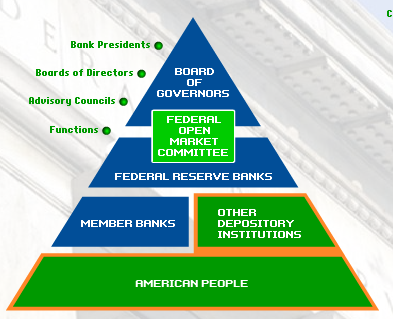
This picture, which I have taken to calling the "Pyramid of Shame" is a pretty good graphical representation of the banking system. As you can see, as usual, we are all the way at the bottom.
Banks can be broken up into two distinct classes, Fed member banks and 'other institutions'. Those other institutions, for example, are made up of Credit Unions, savings and loans, and other institutions sometimes known as "Thrifts". Let me tell you right now, the MAIN difference between a thrift and a commercial bank is that commercial banks are FOR PROFIT and credit unions are NOT-FOR-PROFIT! In other words, guess who's going to pay you more interest, charge you less interest, and screw you over with fewer fees? But I am jumping ahead of myself here...
Above the regular banks are the "Federal Reserve Banks", the Fed breaks the country up into 12 sectors as you can see below;

Interestingly enough, the Northeast, as you can tell, is where the power is... in fact, the New York Fed not only has a PERMANENT seat at the Fed Open Market Committee, but they also have more money in their coffers than pretty much anyone else. These Federal Reserve banks are not regular banks where you and I can walk in and cash a check. In essence, they are the banker to the banks... Here in Miami we have a branch of the Federal Reserve Bank of Atlanta (It's in Doral)
Each one of those regional banks has a president. And each one of those presidents takes a rotating seat on the next step on our Pyramid of Shame, the Federal Open Market Committee! The FOMC is comprised of 12 voting members. These 12 members consist of the members of the Federal Reserve board, of which there are 7, and 5 Fed Bank Presidents who rotate yearly. These are the guys who decide what interest rates are going to be by flipping coins, and set monetary policy with their Alan Greenspan Ouija board.
Above them (and also part of them), is the almighty and infallable Board of Governors! They are led by this guy, Hamid Karzai look-alike Ben "It's a TARP" Bernanke!

I love that picture... it's like he's just shrugging his shoulders and giving up.
Now what, exactly, these guys do is a mystery to me. According to their own website, they help implement monetary policy and govern the 12 Federal Reserve banks. From what I can gather, it seems to me to be a really sweet 14-year appointment, nice job security...
That's it in a nutshell! This is how the banking system is set up in this country... In our next chapter we will learn how the banking system actually WORKS. If, it actually works. Once we've got that under wraps we can start talking about how to actually win against these assholes and how not to become one of the victims of this hideously missguided financial system. I encourage you to share these blogs with someone you love, the bank account you save may be your own!


The federal reserve was set up in 1913 from the federal reserve act. I dont know what the glass act is, maybe your thinking of the Glass-Steagall act but that wasnt passed until 1933 after the great depression. and really:"to do the voodoo that only they know how to doodoo". If your trying to write a decent article why would you put shit like that in there.
ReplyDelete